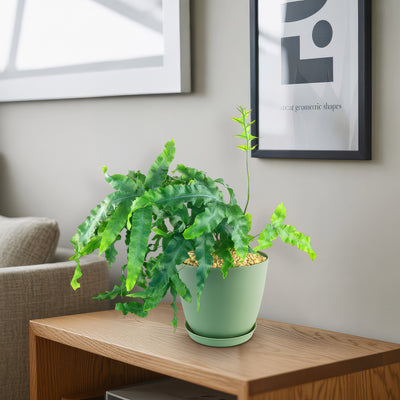
indoor small fern plant Blue Star Fern ‘Phlebodium aureum’ 2 Gal. / Self Watering / Without Pot
SKU: 95625437519
indoor small fern plant

indoor small fern plant Blue Star Fern ‘Phlebodium aureum’ 2 Gal. / Self Watering / Without Pot

Sale price$21.07 Regular price$23.41
Save 10%

Pay in installments of $5.85 with ShopPay, AfterPay and Klarna

Shipping Estimate
USA
  • USA
  • CAN

Ships within 48 hours · Estimated delivery Jul 4 - Jul 9

Promo Codes Available:

For Your Every Summer RSVP, with Code: SUMMER15

Description

indoor small fern plant Blue Star Fern ‘Phlebodium aureum’ 2 Gal. / Self Watering / Without PotThe Blue Star Fern, known as Phlebodium aureum, is a unique and increasingly popular fern for beginners as needs less humidity than other varieties. Its broad, blue green fronds have an unusual, almost wavy texture that lends an exotic feel to any indoor space. In the wild, it grows epiphytically on trees, making it well suited for mounting on surfaces or planting in hanging baskets where its fronds can cascade beautifully. Native to South and Central

The Blue Star Fern, known as Phlebodium aureum, is a unique and increasingly popular fern for beginners as needs less humidity than other varieties. Its broad, blue-green fronds have an unusual, almost wavy texture that lends an exotic feel to any indoor space. In the wild, it grows epiphytically on trees, making it well-suited for mounting on surfaces or planting in hanging baskets where its fronds can cascade beautifully.

Native to South and Central America, the Blue Star Fern gets its name due to the soft, bluish hue of its fronds that resemble star-like shapes when viewed from above.

It has several other common names such as Blue Star Fern, Cabbage Palm Fern, Golden Polypody, Gold Foot Fern, Hare Foot Fern, and Rabbits Foot Fern.

Its popularity stems not only from its visual appeal but also from its ability to improve indoor air quality, making it an attractive, functional addition to any home or office.

A popular feature of the Blue Star Fern is its deeply lobed, velvety fronds, which can grow up to 2 feet long and spread up to 6 feet wide in ideal conditions.

The fronds emerge from a creeping rhizome, which often has a slightly golden tint, adding an additional layer of color to the plant’s appearance.  Its foliage has a soft, almost fuzzy texture, giving it a unique tactile quality not commonly found in other ferns. 

The large blue star fern is a striking addition to any indoor plant collection, with its vibrant color and unique shape.   Its moderate growth rate allows it to fill its space gradually, making it easy to care for and less prone to outgrowing its container quickly.  

As a non-flowering plant, the Blue Fern does not produce blooms, but its vibrant foliage more than compensates for the lack of flowers, providing year-round greenery and aesthetic appeal. 

When and How to Water Your Blue Star Fern 

The Blue Star Fern requires less water and easier to care for than other ferns. This fern is somewhat more resilient than typical tropical varieties, able to go a bit longer between watering sessions without suffering damage. However, allowing the soil to completely dry out is not recommended, as it can lead to stress and browning of leaves.  

In the spring and fall, during the growing season, your Blue Star Fern requires more frequent watering. Water it thoroughly whenever the top inch of soil feels dry to the touch. In most indoor environments, watering every 7–10 days is ideal, depending on the humidity levels. The goal is to keep the soil evenly moist but not soggy, as waterlogged conditions can harm the plant’s delicate roots. Adjust the frequency based on your home’s temperature and humidity; higher temperatures or drier air may require more frequent watering. 

In late fall and winter, during its dormancy period, the Blue Star Fern’s water needs decrease significantly. Water only when the soil is nearly dry, roughly every two to three weeks, as the plant’s growth slows and its water usage drops. The plant can withstand brief periods of dryness during dormancy but will benefit from occasional misting if indoor air is particularly dry. This more conservative watering schedule helps the fern maintain health without overstimulating it during its resting phase.

Light Requirements – Where to Place Your Blue Star Fern 

When growing indoors, Blue Star Ferns prefer bright, indirect light for around 6–8 hours daily. Position it near a north- or east-facing window where it can receive gentle morning sunlight or filtered light throughout the day.

Direct sunlight should be avoided, as it can cause the leaves to scorch and fade in color.

In lower-light settings, this fern can still thrive, although its growth may slow slightly. Supplemental artificial lighting can help maintain vibrant foliage in dim indoor spaces.

For outdoor cultivation, place your Phlebodium aureum blue star in a shaded or partially shaded area.

A spot under a canopy or larger tree where it receives dappled sunlight for part of the day is ideal.

If the plant shows signs of fading color or wilting, try relocating it to a spot with more filtered shade.

Optimal Soil & Fertilizer Needs 

Blue Star Ferns thrive in well-draining, organic-rich soil that retains moisture but doesn’t become waterlogged. An ideal mix for indoor potted plants is a combination of standard potting soil and orchid bark or perlite to enhance drainage. Ideally, you want to use our specialized potting mix, opens in a new tab that contains 5 natural substrates and organic mycorrhizae to promote the development of a strong root system that helps your ferns to thrive.   

For fertilizer, Blue Star Ferns benefit from light feeding during the growing season, roughly once a year from spring to early fall. Use a balanced, NPK fertilizer with an equal ration of about 5-10-5 to avoid overwhelming the plant. Avoid high-nitrogen fertilizers, as these may encourage foliage growth at the expense of root health. During the dormant winter months, fertilizing holds off, as the fern’s nutrient requirements are minimal when growth slows.

Hardiness Zones & More 

When grown indoors, your Blue Star Fern thrives in moderate, indirect light and prefers a consistent indoor temperature range between 60-75°F, making it ideal for home environments. It does best when shielded from direct sunlight, which can scorch its fronds but also needs ample ambient light to thrive. The Blue Star Fern appreciates moderate humidity levels of 40-60%, which can be achieved with a humidifier or occasional misting, particularly in winter or dry climates.

For outdoor cultivation, this fern is suited for USDA Zones 8-12, where it can survive mild winters but will require a shaded spot to avoid excessive sun exposure. It can withstand temperatures down to 20°F but should be protected from frost and intense afternoon sun.

It also benefits from higher humidity, so if grown in drier zones, placing it near water features or misting it occasionally will help maintain its lush appearance. The blue star fern's dry leaves are a sign that it needs more humidity in its environment. Make sure to mist the plant regularly or place a humidifier nearby to help prevent further leaf dehydration.  

Wildlife Blue Star Fern Attracts the Following Friendly Pollinators 

While Blue Star Fern is not a traditional pollinator attractant like flowering plants, it creates a welcoming environment for beneficial insects that support local biodiversity. Its dense fronds provide shade and moisture, which helps attract small, beneficial creatures in shaded outdoor gardens.

Butterflies
Bees
Hummingbirds
Lady Bugs
Multi Pollinators
Other Birds

According to the ASPCA, Blue Star Fern is non-toxic to humans, cats, dogs, and birds. This makes it an ideal choice for pet-friendly homes, as it poses no risk to animals that may chew on their fronds. 

How to Propagate Your Phlebodium aureum 

To propagate Blue Fern, start by dividing its rhizomes during spring or early summer. Gently remove the plant from its pot, shake off excess soil, and separate the rhizomes into smaller sections, each with fronds and roots. Replant each division in a suitable pot with fresh, well-draining potting mix, water thoroughly, and place in a warm area with indirect light. Within a few weeks, the new divisions should begin to establish, showing signs of growth. 

Key Takeaways

  1. In the wild, it grows epiphytically on trees, making it well-suited for mounting on surfaces or planting in hanging baskets where its fronds can cascade beautifully.
  2. Its unique blue-green, wavy fronds with a soft, almost velvety texture give it a distinctive look, making it a striking and popular choice for indoor decor.
  3. Blue Star Fern is a low-maintenance plant that tolerates lower light levels, and indirect light and requires minimal care compared to many other ferns, making it well-suited for beginners.
  4. The blue fern can tolerate mild frost in USDA zones (8-12) and lower temperatures for short periods, making it versatile for indoor and sheltered outdoor use in suitable climates.
  5. Unlike many other ferns, Blue Star Fern has some drought tolerance and can go without frequent watering, though it prefers consistently moist soil.

The Bottom Line 

Overall, the Blue Star Fern (Phlebodium aureum) is a distinctive and popular houseplant that brings a touch of the tropics indoors with its striking blue-green, wavy fronds and epiphytic nature. Known for its adaptability, this fern thrives in moderate, indirect light and can tolerate occasional drought and lower humidity, making it easier to care for than many other ferns. While it prefers consistently moist soil, it is relatively low-maintenance and capable of withstanding mild frost, making it a versatile option for a range of indoor and sheltered outdoor spaces. With its unique appearance, air-purifying benefits, and pet-safe qualities, the Blue Star Fern is an excellent choice for anyone seeking a beautiful, easy-to-care-for addition to their plant collection. 

Shipping Notes
  • Free Standard Shipping on $100+ Orders to the USA.
  • Except Preorder products are shipped in 48 hours.
  • Delivery to the USA:
  1. Standard Shipping : 3-10 business days
  • If time is of the essence, please consider selecting expedited delivery for faster service.
Exchange/Return Notes
  • We offer a 30-day return/exchange service after receiving.
  • Final sale items are not eligible for returns or exchanges.
  • To process your return/exchange, please contact us at [email protected]
  • Please click here for more details>>> Return & Exchange Policy
SKU: 95625437519

Discover Niche Categories That Outsell indoor small fern plant

Top-Converting Item to Boost Your Average Order

4.7 ★★★★★
Based on 1094 reviews
Sort
Highest Rating
Newest First
Oldest First
Product Reviews
M
Verified Purchase
Matthew
Battle Creek, US
★★★★★ 1
Poor read
Format: Paperback
Not worth the hype. Was poorly written and had to put it down and not finish it.
WAS THIS REVIEW HELPFUL?YesReportShare
Reviewed in the United States on May 20, 2025
T
Verified Purchase
T
Omaha, US
★★★★★ 4
Great story
Format: Paperback
I’m not an avid reader, but this was finished in a few days. Such a good book!
WAS THIS REVIEW HELPFUL?YesReportShare
Reviewed in the United States on June 14, 2025
A
Verified Purchase
AMD
San Leandro, US
★★★★★ 3
Won’t be buying book two.
Format: Paperback
Entertaining enough but poorly written. Lots of typos. Won’t be buying book two.
WAS THIS REVIEW HELPFUL?YesReportShare
Reviewed in the United States on July 8, 2025
D
Verified Purchase
Dr.C.J.Singh.Wallia
Waukegan, US
★★★★★ 5
An Excellent Primer on Novel-Writing
Format: Paperback
WIRED FOR STORY By Lisa Cron Reviewed by C J Singh (Berkeley, California) Excellent Primer on Novel-Writing In Berkeley, California, we happily have access to four independent bookstores that display literary novels and creative-writing craft books. Browsing, I picked up two books by Lisa Cron on using "Brain Science" for writing fiction. The jacket quote by Caroline Leavitt rivetted my attention: "I'd never consider writing a novel without Lisa's input, and neither should you." As a longtime fan of Leavitt's novels "Is This Tomorrow," " Pictures of You, " "Girls in Trouble," I looked up Stanford Continuing Education where Leavitt regularly teaches online courses. As a Stanford Alumnus (Psychology PhD), I've taken several on-campus and online workshops on fiction-writing. While still at the bookstore, I promptly signed up for Leavitt's soon-to-begin course that uses two coaching books: Cron's Wired For Story and John Truby's The Anatomy of Story. I'm familiar with Truby's book and its nine excellent exercises. See my detailed review on amazon: https://www.amazon.com/review/R29NU7U6LAHGBV/ Here's my review of Lisa Cron's "Wired For Story" "WIRED FOR STORY' presents a unique, distinguishing feature among fiction-writing primers: throughout its text, the author includes excerpts from the published works of leading contemporary brain-scientists that validate the principles of narrative craft. Cron explains the principles of narrative craft in twelve well-organized chapters that focus on theme, the protagonist's issue, characters' bios, points of view, rising conflicts, subplots, suspense, reveals, and the arc from setup to payoff. At the beginning of each chapter, she presents sentences in italics that illuminate the cognitive-science underpinnings of narrative craft. Examples follow. "Cognitive Secret: When the brain focuses its full attention on something, it filters out all unnecessary information. Story Secret: To hold the brain's attention, everything in a story must be there on a need-to-know basis" (page 23). . "Cognitive Secret: Everything we do is goal directed and our biggest goal is figuring out everyone else's agenda, the better to figure out our own. Story Secret: A protagonist without a clear goal has nothing to figure out and nowhere to go" (p 65) . "Cognitive Secret: It takes long-term, conscious effort to hone a skill before the brain assigns it to the cognitive unconscious. "Story Secret: There's no writing; there's only rewriting" (p 219). Also remarkable are sentences in bold that challenge advice offered in some writing-craft workshops and books. Examples follow. "Myth: Write What You Know. "Reality: Write What You Know EMOTIONALLY" (p 62). . "Myth: Sensory Details Bring a Story to Life." "Reality: Unless They Convey Necessary Information, Sensory Details Clog a Story's Arteries" (p 118). . "Myth: `Show, Don't Tell' Is Literal - Don't Tell Me John Is Sad, Show Him Crying. "Reality: `Show, Don't Tell Is Figurative - Don't Tell Me John Is Sad, Show Me WHY He's Sad" (p 152). Has the author introduced a Myth of her own? I am afraid so. On page 57, "No matter whose point of view you're writing in, you may be in only one head per scene." In my opinion, the Reality is: No matter whose point of view you're writing in, you may be in only one head per PARAGRAPH. This is the new reality -- virtually every fiction-readers' perception has been reshaped by watching films and TV dramas that imply the camera engaged in frequent head-hopping in a scene. At the end of each chapter, Cron presents a concise series of checkpoints to remind the readers while they develop their work-in-progress. Throughout, she includes many examples from literary works and films. Literary works like Gabriel Marquez's "Love in the Time of Cholera," Margaret Mitchell's "Gone with the Wind," and Caroline Leavitt's "Girls in Trouble." Films like "It's a Wonderful Life," "Vertigo," and "American Graffiti." An inspiring citation for writers: " `Recent breakthroughs in neuroscience reveal that our brain is hardwired to respond to story.... It turns that a powerful story can have a hand in rewiring the reader's brain -- helping empathy, for instance - `which is why writers are, and always have been among the most powerful people in the world'. " (On p 239 of Endnotes is the specific citation of three scientists' 2009 article "On Being Moved by Art: How Reading Fiction Transforms the Self" in the Creativity Research Journal vol. 21, no.1 ) WIRED FOR STORY fully earns its title with its numerous citations of recent contributions of neuroscience that validate narrative craft. Examples of cited works included are: V. S. Ramachandran's "The Tell-Tale Brain: A Neuroscientist's Quest for What Makes Us Human"; Michael Gazzaniga's "Human: The Science Behind What Makes Your Brain Unique; and Steven Pinker's "How the Mind Works." These stellar books illuminate the nexus between art and science; their shining light reflects on Lisa Cron's book as a five-star primer for novel-writing.
WAS THIS REVIEW HELPFUL?YesReportShare
Reviewed in the United States on March 7, 2020
M
Verified Purchase
Matt M
Fort Morgan, US
★★★★★ 5
Will reading Wired for Story really make you smarter?
Format: Paperback
In my 36th year as a would-be and penniless writer, I found myself exiled to a dark rough and tumble city in the Far West, guns blazing as a steely-eyed wordslinger for hire. But then one day I stumbled upon Lisa Cron's book Wired for Story. The book's title had my curiosity. A few sample pages later grabbed my attention and has held it ever since. But the price wasn't right for a poor, humble English teacher living in China upon a Chinese salary. I had bills to pay, a mistress to please, and habits to feed. It seemed to me that Amazon.com was colluding with other dark powers to suck humanity dry; why else would they charge more for a digital book than its paper copy? But then I heard ghostly voices, the cinematic intonations of Morpheus telling me to choose between the red and blue pill; Obiwan Kenobi, "Use the Force"; Nike commercials, "Just Do It!"; and other such shadows flickering upon the wall of my TV room. Even this very particular retail website seemed to whisper across all the vastness of cyberspace, reminding me of my destiny via a personalized showcase of products, that I was not just born to buy... So I added it to my cart. About a download and two chapters later I found that I was still happy after the post-purchase buzz ran its course. This book should be required reading for all writers - and anybody else seeking an inoculation against the raging pandemic of competing narratives spewed out from marketers, pundits, prophets, and others posing as guardians of the truth - most of whom seem to be more enraptured than enlightened. For writers though, Wired for Story is quite different from other "how to" books, as Lisa Cron approaches the craft of storytelling from a neuroscientific point of view. She makes the case that writers aren't just entertainers: they are some of most powerful shakers and shapers of human perception. So if storytellers are like snake oil salesmen, then what is the difference? Both seem to be highly skilled in crafting story, using imagery, and evoking emotions, memories, desires. The difference is all about marketing. Salesmen claim to have knowledge, skills, and expertise, that they, and they alone have whatever it takes to get the facts right and fix things. They market their brands cloaked in story, as if they have a monopoly on truth, or at least the can-do spirit and problem-solving experience needed to improve the economy, save the world, whatever. It doesn't matter that time and time again reality proves them wrong; they will always have another story to spin. The difference between those who would use the power of story to express themselves versus those who would use it for personal gain is, perhaps, a fine red line marking the shadowy borders of between ethics and morality. Storytellers differ because they use words to hook audiences and manipulate a willing reader's central nervous system. They make no claims to knowledge or expertise. Indeed, fiction writers will be first to emphasize their work is fictional, and not based on any real life events or people. Their best writing leaves readers thinking, questioning, minds opening, empathizing, expanding their worldviews, the list goes on almost ad infinitum. Storytellers speak for themselves and let audiences think for themselves; pundits speak for others and tell audiences what to think. What's more, the art and craft of story, as well as the talent and hard time in solitary confinement required for their honing, is estimated to take an average storyteller at least 1,000,000 words or 10,000 hours - not including all the reading, language arts development, and life experience necessary to get to a point one needs to seriously embark on such a ludicrous and un-economical vocation. This means that fiction writers who risk everything for dubious prospects of financial reward must have something else driving them - and a good day job. A presidential candidate though, who has genuinely done the time, and crafts speeches with the skill of a poet or bard, should hypothetically have the critical thinking background, moral authority, and empathy to be a great leader. But in the final analysis, actions contradict words; their ability to spin tales proves the old universal theme that the pen is mightier than the sword. Now when I finish Wired for Story sometime this week, I will be one step further on this endless quest to actually sell stories for a living (i.e. stories fit for the fiction aisle of an actual bookstore, not a review for an online retailer). Until then, I'm probably just a hypocrite acting as if a single book alone makes a smarter man, when in fact I know little of anything (which is why I became a writer in the first place) -- or maintaining such a humble pretense. But I don't know myself well enough to be certain. That kind of exploration would be a whole other story - but it would be unsafe to say that I lived happily ever after reading this book. The End
WAS THIS REVIEW HELPFUL?YesReportShare
Reviewed in the United States on October 11, 2012

recommand products